

The United Arab Emirates is widely recognized as one of the most digitally advanced nations in the world, with near-universal access to high-speed internet fundamentally shaping how residents live, work, and interact. From ultra-HD video streaming and competitive online gaming to remote work, cloud-based collaboration, AI-driven productivity tools, and fully automated smart home systems, internet connectivity in the UAE is no longer a secondary utility, it has become essential digital infrastructure that underpins both personal and professional life.
In this highly connected environment, the discussion of du vs Etisalat has become increasingly important for both households and businesses. These two providers dominate the UAE telecom landscape, and while both deliver strong nationwide coverage, they differ in performance strengths, pricing structure, and overall user experience depending on the type of connection and usage scenario.
As digital demand continues to grow, users now expect more than just basic internet access. They want consistent speed, ultra-low latency, and uninterrupted performance, especially during peak usage hours. This is where the du vs Etisalat comparison becomes more relevant than ever, as both companies compete to deliver reliable fibre and advanced 5G wireless solutions tailored to modern digital lifestyles.
For example, households that rely heavily on streaming platforms, smart devices, and remote work setups often evaluate du vs Etisalat based on stability and peak-hour performance. At the same time, businesses look at factors like uptime reliability, scalability, and support for cloud-based operations before making a decision.
Ultimately, in 2026, the choice between du vs Etisalat is not just about internet speed, it is about choosing a digital experience that aligns with how connected life has become in the UAE.
In such a highly connected environment, home internet is not optional. It is a core enabler of productivity, entertainment, communication, and increasingly, business continuity for freelancers, entrepreneurs, and remote professionals. As digital dependency continues to grow in 2026, selecting the right internet provider has become a strategic decision rather than a simple subscription choice.
This naturally leads to one of the most important questions for UAE residents:
Which is better in 2026: du or Etisalat?
Both du and Etisalat (operated under e& branding) dominate the UAE telecommunications market and offer advanced connectivity solutions, including fibre-optic broadband, 5G home internet, and integrated entertainment bundles. At a surface level, their services may appear similar in terms of advertised speeds and package structures. However, real-world performance differences in latency, network stability, pricing transparency, contract flexibility, and infrastructure consistency make this comparison significantly more important than it initially seems.
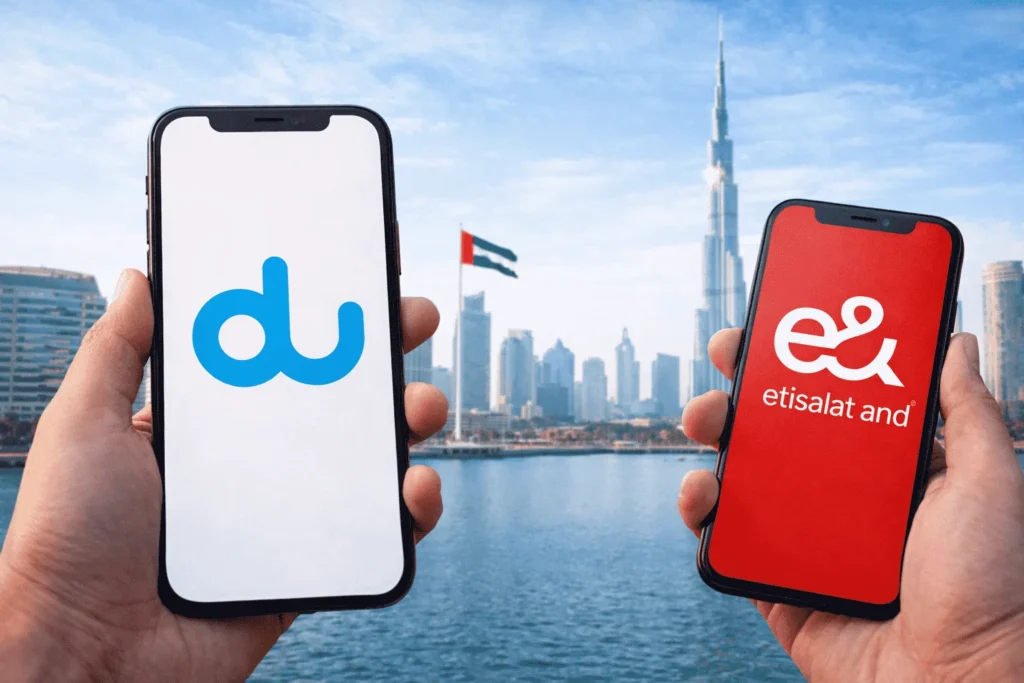
Why This Comparison Matters in 2026 (du vs Etisalat)
The UAE internet ecosystem has evolved rapidly over the past decade, driven by major technological upgrades, nationwide infrastructure expansion, and a significant shift in how users consume digital services. As a result, the du vs Etisalat comparison in 2026 is no longer a simple pricing or speed debate, it has become a strategic decision that directly affects both personal and business digital experiences.
Modern internet usage patterns clearly show that users are no longer evaluating providers based only on basic connectivity. Instead, they are looking at real-world performance, reliability under load, and long-term value across different usage scenarios.
Key Industry Shifts Shaping du vs Etisalat in 2026
Several major developments now define how users experience home and business internet in the UAE:
- Nationwide expansion of fibre-optic infrastructure across urban, suburban, and developing regions
- Rapid adoption of 5G home internet solutions as a flexible alternative to fixed broadband
- Increased dependence on low-latency connections for gaming, trading platforms, and real-time collaboration tools
- Massive growth in cloud computing, AI-powered applications, and high-bandwidth video conferencing
- More complex telecom ecosystems with bundled services, promotional pricing, and long-term contracts
These changes have significantly increased the importance of evaluating du vs Etisalat beyond surface-level marketing claims.
Why the du vs Etisalat Decision Now Matters More Than Ever
In 2026, choosing between internet providers directly influences multiple critical aspects of daily digital life:
Work Efficiency & Productivity
A stable connection is now essential for remote work, virtual meetings, and cloud-based collaboration tools. Even minor disruptions can impact business performance.
Gaming & Real-Time Applications
Competitive online gaming and trading platforms require ultra-low latency. In the du vs Etisalat comparison, consistency matters more than peak speed.
Streaming Quality & Entertainment Experience
Users expect buffer-free streaming in HD and 4K. Network stability during peak evening hours has become a key decision factor.
Long-Term Cost & Contract Value
Beyond performance, households and businesses must also consider long-term pricing structures, contract flexibility, and hidden cost implications.
Real-World Decision Impact
From a real-world perspective, the du vs Etisalat decision is increasingly influenced by actual user experience rather than theoretical speed claims. Factors like local network congestion, building infrastructure, and service reliability often determine satisfaction more than advertised packages.
This is why industry experts emphasize evaluating providers based on:
- Location-specific performance
- Peak-hour stability
- Customer support reliability
- Scalability for future digital needs
Final Takeaway
Given these evolving conditions, a structured and evidence-based comparison of du vs Etisalat is not just helpful, it is essential. In 2026, internet connectivity is no longer a utility you simply choose; it is a foundation that shapes productivity, entertainment, communication, and overall digital lifestyle in the UAE.
du vs Etisalat: Quick Strategic Overview
Du Overview (2026)
du positions itself as a more flexible, value-oriented telecom provider in the UAE, focusing on accessibility, affordability, and quick deployment options.
Core offerings include:
- Fibre broadband plans ranging from mid-tier to ultra-fast gigabit speeds (up to 1 Gbps in selected areas)
- 5G home wireless internet designed for plug-and-play convenience
- Bundled entertainment packages combining internet and streaming services
Best suited for:
- Budget-conscious households
- Renters and short-term residents
- Small to medium-sized households with moderate usage needs
Key strength:
Affordability combined with flexible deployment options, particularly 5G home internet that requires minimal installation and setup time.
Etisalat Overview (2026)
Etisalat is widely regarded as the premium-tier provider in the UAE, known for its infrastructure depth, network consistency, and enterprise-grade performance.
Core offerings include:
- eLife fibre broadband with multi-gigabit capabilities in select areas
- Fully integrated packages combining internet, television, and landline services
- Advanced network infrastructure supporting both residential and enterprise users
Best suited for:
- Heavy internet users and remote professionals
- Competitive gamers requiring low latency
- Large households with multiple connected devices
Key strength:
Consistent performance, strong nationwide coverage, and highly stable connectivity even during peak demand periods.
Key Differences: du vs Etisalat
| Factor | du | Etisalat |
| Market Positioning | Budget-friendly | Premium provider |
| Network Stability | Good but variable | Highly stable |
| Pricing Structure | Lower entry cost | Higher but bundled value |
| Contract Flexibility | More flexible | Typically 12–24 months |
| Customer Support Consistency | Mixed user feedback | More consistent service experience |
Speed and Performance Comparison
du Performance Profile
du delivers competitive speeds across both fibre and 5G platforms:
- Fibre broadband up to 1 Gbps in supported areas
- 5G home internet typically ranging from 100–500 Mbps depending on signal conditions
However, real-world performance may vary due to:
- Peak-hour congestion in densely populated areas
- Variable upload stability in some residential zones
- Dependence on wireless signal strength for 5G services
Overall, du performs well for general usage such as HD streaming, web browsing, and everyday household connectivity.
Etisalat Performance Profile
Etisalat generally delivers more consistent high-performance connectivity:
- Multi-gigabit fibre availability in select locations
- Strong upload and download symmetry for professional use cases
- Minimal performance degradation during peak usage periods
This is largely attributed to:
- A more mature national backbone infrastructure
- Advanced traffic management and routing systems
- Higher investment in long-term network stability
As a result, Etisalat is typically better suited for latency-sensitive activities such as gaming, remote work, and large-scale cloud usage.
Real-World Performance Insight (2026 UAE Usage Patterns)
- Apartments: Both providers perform adequately, though Etisalat is generally more stable
- Villas: Etisalat tends to outperform due to stronger infrastructure support
- Peak hours: du may experience variability depending on network congestion
- Streaming and conferencing: Etisalat offers more consistent high-quality performance
Pricing and Value Comparison
du Pricing Structure
du typically offers:
- Entry-level plans: AED 199–299
- Mid-tier bundles: AED 300–450
- 5G wireless plans: competitively priced with minimal installation requirements
Potential additional costs may include:
- Router fees (often waived in promotional offers)
- Installation charges depending on package
- Early termination fees for contract-based plans
Etisalat Pricing Structure
Etisalat pricing generally starts higher:
- Entry-level fibre plans: from approximately AED 299+
- Premium bundles: AED 400–700+ depending on speed and services
These packages often include:
- Television subscriptions
- Landline services
- Premium support tiers
Reliability and Stability
In terms of real-world reliability, fibre-optic infrastructure remains significantly more stable than wireless alternatives such as 5G home internet.
- du offers solid reliability but may vary depending on congestion and location
- Etisalat consistently delivers higher uptime and more stable throughput under heavy load
Key insight: Etisalat’s fibre infrastructure generally provides more predictable performance across diverse environments.
Gaming Performance Comparison
Latency is a critical factor for gaming performance.
- du: ~15–30 ms latency (varies by location and congestion)
- Etisalat: ~5–15 ms latency (more stable routing paths)
For competitive gaming, Etisalat is generally preferred due to:
- Lower packet loss
- More stable routing architecture
- Reduced jitter during peak hours
Coverage Across the UAE
- du: Strong presence in newer residential developments and expanding 5G coverage
- Etisalat: Broader nationwide infrastructure with stronger consistency in older and high-density areas
Final Verdict (2026)
Both providers play essential roles in the UAE’s digital infrastructure, but they serve slightly different user profiles:
du = Flexibility + Affordability
Best for:
- Budget-conscious users
- Short-term residents
- Users comfortable with variable performance in exchange for lower cost
Etisalat = Performance + Stability
Best for:
- Gamers
- Remote professionals
- High-demand households with multiple devices
Bottom Line
There is no universal “best” internet provider in the UAE. The right choice depends on your location, usage behavior, and performance expectations.
In 2026:
- du prioritizes affordability and flexibility
- Etisalat prioritizes stability and performance
FAQs
1. Is du cheaper than Etisalat in the UAE?
Yes, du generally offers lower starting prices and more flexible entry-level plans.
2. Which internet is faster in the UAE?
Etisalat is typically faster and more stable, especially on fiber connections.
3. Is 5G better than fiber?
No. Fiber is more stable, reliable, and better for heavy usage.
4. Which is best for gaming?
Etisalat due to lower latency and more stable routing.
5. Can I switch providers easily?
Not always. Availability depends on building infrastructure and location.
Disclaimer
This comparison is based on commonly observed UAE telecom infrastructure patterns, publicly available service structures, and aggregated real-world user experience trends across both urban and residential areas. In simple terms, it reflects how du vs Etisalat generally perform in everyday usage rather than relying only on theoretical or marketing claims.
It’s important to understand that internet performance in the UAE is influenced by multiple real-world factors, not just the provider name or advertised package. Even two users on the same plan may experience different results depending on their exact location and setup conditions.
Actual internet performance may vary based on several key elements, including:
- Building infrastructure and internal wiring quality
- Neighborhood-level network congestion during peak hours
- Distance from network distribution points or towers (especially for 5G)
- Selected package tier and bandwidth allocation
- Installation quality and router configuration
Because of these variables, du vs Etisalat should always be evaluated in the context of real-world usage rather than only comparing headline speeds or promotional offers. What works perfectly in one area may perform differently in another, especially in high-density residential or mixed-use zones.
From a practical standpoint, users in the UAE are encouraged to look beyond basic pricing and focus on how the connection performs during their actual daily activities, such as video calls, streaming, gaming, or cloud-based work tools.
Finally, while this comparison is designed to provide a clear and realistic overview of du vs Etisalat, users should always verify the latest pricing, promotional offers, coverage availability, and technical specifications directly with the official provider before making a final subscription decision. This ensures they receive the most accurate and up-to-date information tailored to their specific location and requirements.